
SpatioTemporal founder Andrew Ballard has been interviewed by The Data Wire for a feature exploring a growing challenge for Physical AI: how to extract the signals that matter without carrying the enormous computational burden of continuous video.
The article, “Physical AI Needs Better Signals, Not Bigger Data Pipelines,” examines SpatioTemporal’s approach to representing movement mathematically rather than asking increasingly large models to infer everything from pixels. (The Data Wire)
At the centre of the discussion is a simple principle: more data does not necessarily create more intelligence.
Modern perception systems can capture extraordinary amounts of information about the physical world. For robots and autonomous systems, however, much of that information may have little bearing on the decision that needs to be made next.
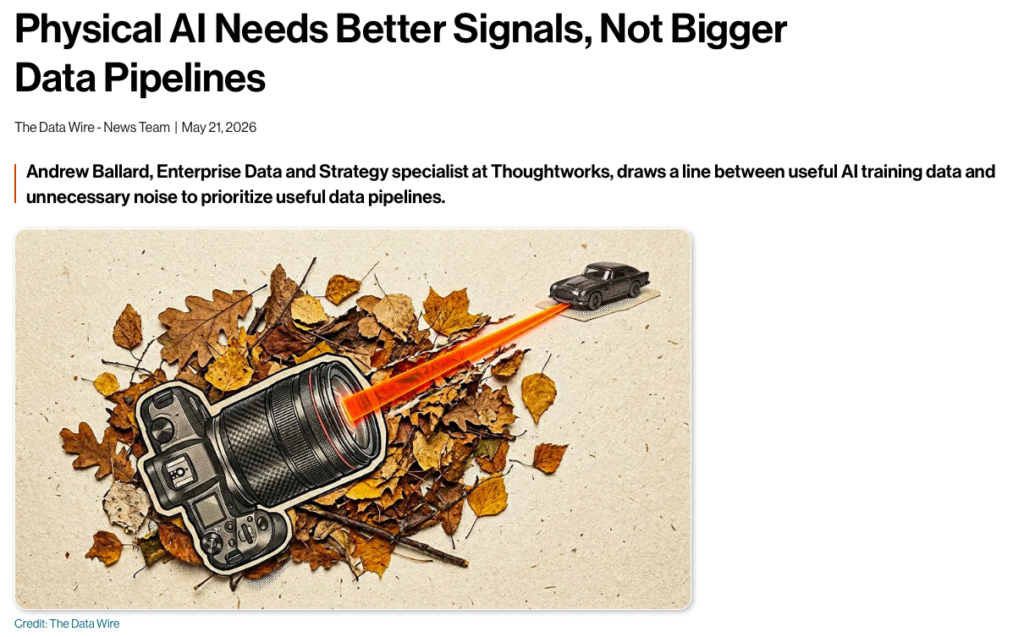
A person changing pace matters. A vehicle beginning to drift matters. Leaves moving on a tree usually do not.
SpatioTemporal approaches this problem by compressing space and time into motion tokens, creating a lightweight mathematical representation of how objects move rather than retaining the full visual scene. The Data Wire highlights how this can reduce the underlying data requirement by several orders of magnitude while preserving the motion signals needed for prediction and reasoning. (The Data Wire)
The interview also explores the deeper objective behind that compression: understanding intent.
Perception can identify a pedestrian and determine their position. Motion Intelligence asks a different question. Is that person waiting, distracted, rushing, hesitating or beginning to cross?
Those distinctions are intuitive to humans because we continuously interpret the grammar of movement around us. Giving machines access to similar signals could help bridge what SpatioTemporal describes as the missing middle layer between perception and planning.
The article also discusses SpatioTemporal’s work with NVIDIA Cosmos, where motion-derived intent signals reduced near-collision events by around 90% in simulation, alongside experiments running the underlying models directly on smartphone-class edge hardware. (The Data Wire)
For Physical AI, the implication is important. Progress may not depend solely on larger models, more cameras and heavier compute. There is another path: finding better representations of the physical signals that actually matter.
For SpatioTemporal, movement is one of those signals.
Robots that read the room. Cars that read the road.