
Léo Morillon, who writes about the emerging robotics stack, described a robot brain being divided by latency: “Rent the plan, not the reflex.”
The premise is straightforward. Some parts of a robot’s intelligence can move to the cloud. Others physically cannot.
A humanoid balancing on two legs may be correcting itself hundreds of times per second. A gripper detecting an object beginning to slip has milliseconds to respond. Sending that problem to a data centre and waiting for an answer is pointless. By the time the response returns, the robot is on the floor or the object is broken.
Higher-level planning is different. Deciding how to clean a room, which object to pick up next, or how to approach a task can tolerate hundreds of milliseconds, sometimes seconds. Those problems can increasingly be handed to enormous models running remotely.
It’s a compelling way to think about the emerging architecture of Physical AI. But I think there is an important layer missing between the two.
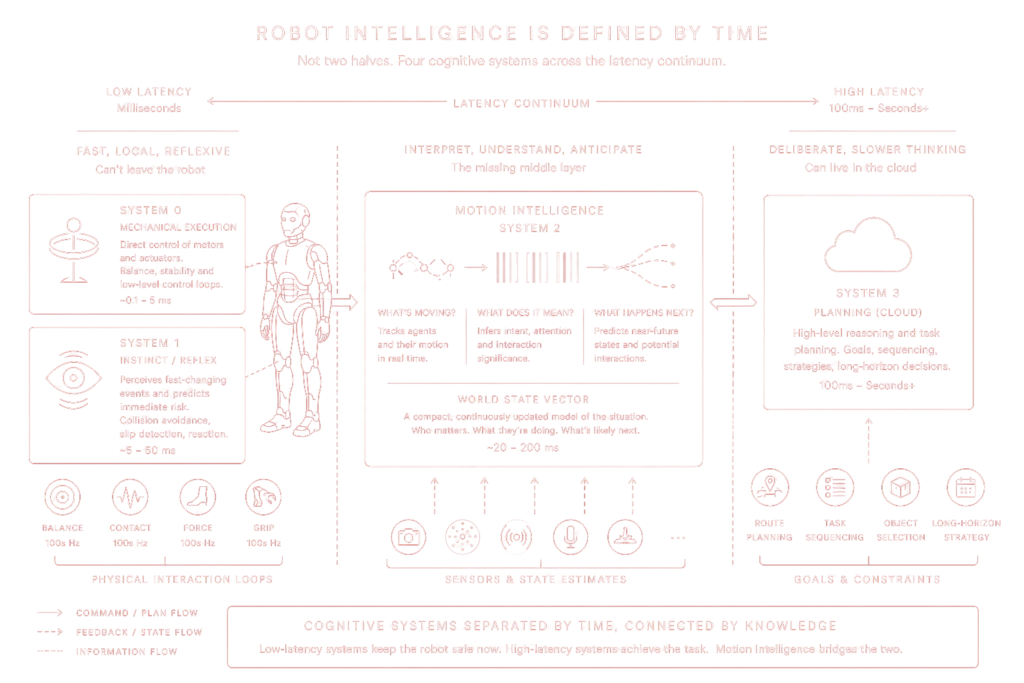
The robot brain may not be splitting into two halves.
It may be separating into cognitive systems defined by time.
From reflex to reason
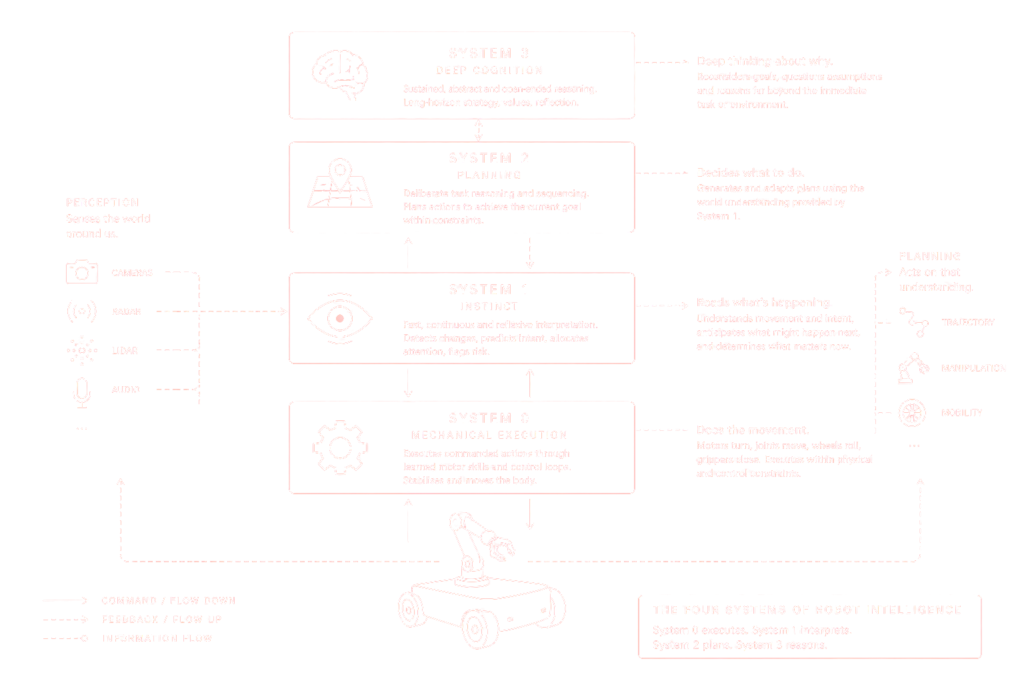
We have been thinking about this at SpatioTemporal as four systems:
System 0 is mechanical. It is the machine maintaining control of its own body: balance, torque, grip, contact and stability. These loops operate in milliseconds. They are inseparable from the hardware.
System 1 is instinctive. It interprets the changing world immediately around the machine. Is that person hesitating? Is the cyclist committing to a turn? Which of the people in this room matters to me right now? Is a movement becoming a threat?
System 2 is task intelligence. It decides what the robot should do: navigate there, pick this up, yield, change course, complete the next step.
System 3 is deep thinking. This is expensive reasoning: novel problems, semantic understanding, long-horizon planning and the increasingly large foundation models that can draw on enormous amounts of knowledge.
These are not just different levels of intelligence. They operate on different clocks.
| System | Function | Rough timescale |
|---|---|---|
| System 0 | Mechanical control and reflex | milliseconds |
| System 1 | Motion, intent, relevance and immediate consequence | tens to hundreds of milliseconds |
| System 2 | Task planning and action | hundreds of milliseconds to seconds |
| System 3 | Deep reasoning | seconds and beyond |
And that changes where each kind of intelligence can live.
The missing band
Morillon’s latency diagram moves from examples such as keeping balance and tightening a slipping grip to deciding what to do and planning a route. There is a lot happening in between.
Imagine a robot moving through a busy hospital corridor:
- System 0 keeps it balanced and prevents the wheels or legs from doing anything mechanically stupid.
- System 2 knows it needs to reach the kitchen.
- System 3 might understand why it’s going there, interpret an unusual instruction, or work out what to do if the task fundamentally changes.
But something still has to interpret the nurse stepping sideways while talking to a colleague. The patient slowing unexpectedly. The person emerging from a doorway. The small hesitation that suggests somebody is about to cross the robot’s path.
Those signals can become irrelevant remarkably quickly.
This is the territory we call System 1. It’s not reflex control. The robot is interpreting behaviour, not simply responding to contact. But it’s not deliberative planning either. Waiting for a large reasoning model to carefully consider the situation may defeat the purpose.
The machine needs to read the room while there is still time to act on what it has read.
Motion as fast intelligence
Humans are extraordinarily good at this. Walking through a crowded space, we do not consciously calculate the trajectories of everyone around us. Most people are barely given conscious attention.
Instead, movement gets compressed into meaning.
- That person is stopping.
- That child might run.
- That cyclist has committed.
- That driver is drifting.
Something about that person’s movement means I should pay attention.
This happens below the level of deliberate reasoning, but it is considerably richer than reflex.
Our work on Motion Intelligence starts from the idea that machines need an equivalent capability. Instead of continuously reasoning over all of the pixels in a scene, we compress space and time into motion tokens: compact representations of how things are moving and how that movement is changing.
The objective is not another perception system or another planner. LSTM-01 is explicitly being developed as a predictive substrate between those layers, modelling motion and interaction rather than replacing perception or control.
That distinction becomes more important when viewed through latency.
Motion Intelligence has a shelf life.
Knowing that someone intended to cross the corridor half a second ago is much less useful after they have already stepped into it.
Latency becomes architecture
This suggests a more nuanced version of the edge-versus-cloud debate.
The question is not simply whether a robot has enough bandwidth to call a remote model. The question is: How long does this piece of intelligence remain useful?
- At System 0, the answer might be milliseconds. The intelligence has to live with the body.
- At System 1, the useful window is larger, but still short. Motion, intent, salience and emerging risk need to be interpreted close to the machine and continuously updated.
- At System 2, there is more flexibility. Some task intelligence can be onboard. Some can be distributed.
- By System 3, the economics change substantially. Deep reasoning can often tolerate network latency, and the attraction of huge shared models running on data-centre compute becomes compelling.
So as we move upward through the systems, cloud suitability generally increases.
That does not mean every robot will have exactly the same architecture. A high-speed autonomous vehicle and a domestic service robot have very different latency budgets.
It means there is an architectural principle emerging:
The shorter the useful lifetime of information, the closer the intelligence needs to remain to the body.
Not one giant robot brain
There is a tendency to imagine the future of robotics as a race towards one increasingly capable model that sees everything, understands everything and controls everything.
Perhaps – but biology offers another possibility, and engineering constraints are pointing in the same direction. The future robot brain may be a hierarchy of specialised intelligences operating at different speeds.
- Some can be enormous.
- Some can be remote.
- Some should be small, fast and almost invisible.
This is also why we think the missing middle between perception and planning deserves more attention. Our current work treats Motion Intelligence as a compact, reusable layer for interpreting changing physical behaviour rather than as an end-to-end robotics system.
As robots leave controlled environments and enter hospitals, workplaces, shops, footpaths and homes, seeing humans will not be enough. Planning around their current coordinates will not be enough either. Machines will need to interpret the tiny movements through which people continuously communicate what they are likely to do next. That intelligence has to arrive before the moment has passed.
So we’re extending “rent the plan, not the reflex” one step further:
System 0 keeps the robot upright.
System 1 reads the room.
System 2 gets the job done.
System 3 thinks deeply.
The cloud may increasingly provide the deepest parts of a robot’s mind. But its instincts will need to travel with it.